Danish Telephone
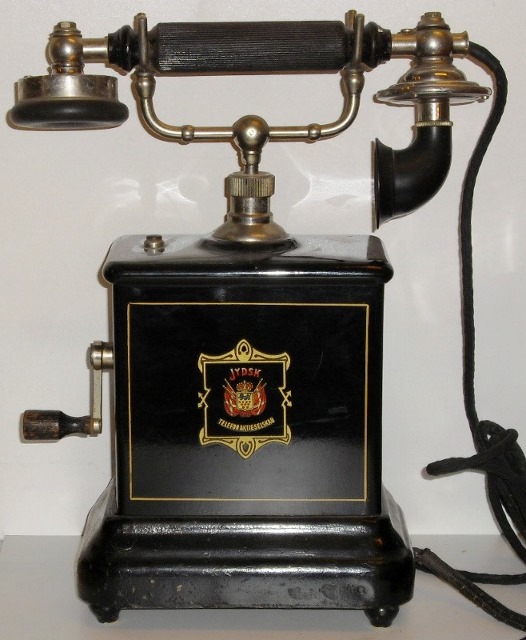
Using a Danish telephone is not difficult, but you may want to know a few simple things that can save you time and money. First the telephone above is not what we are using today - just thought it would be fun to see what was a common phone not too long ago.
If you are placing a call to Denmark you will need to use the prefix 0045. When in Denmark you just need to dial the 8-digit number, since Denmark does not have any area codes.
Most people use mobile phones, but you can find public phone booths, especially at the train stations and major attractions.
For those you use google apps on your mobile phones, Google is adding traffic support for Google Maps in Denmark and 12 other European countries including: Austria, Belgium, Czech Republic, Denmark, Germany, Ireland, Israel, Luxembourg, Netherlands, Poland, Slovakia, Spain and Switzerland.
Alongside live updates, Google will estimate how traffic will look in the near future based on current traffic trends. Download the update at google phone apps
Danish Telephone General Information
Country Code is: 0045.
ISO Country Code is: either DK or DNK
Emergency Number: 112
Danish Online Telephone Directories
- The Danish version of the Yellow Pages is at: www.degulesider.dk
- Enviro has both a person and business directory. Check them out at
www.eniro.dk/ for searching private addresses and use
www.firma.eniro.dk/ for searching for businesses. - Krak is a great and very popular resource which also includes maps, routes and contact details. Check them out at www.krak.dk .
- Gulex is a relatively newer site, which has lots of great options like net searches, business searches, maps and much more. I have actually been using the directory myself much more as I find more options and possibilities here. www.gulex.dk/
- The major danish telephone company is TDC and their site has some options for finding phone numbers, so check out www.tdc.dk.
Since telephone service is very complicated, I have created another page, where you can read my guide on mobile danish telephone services.
Important INFORMATION: If you have a mobile phone with internet capabilities and you are residing in Denmark, you must have a media licence. If you do not have a licence, you can be fined. It is illegal. You have now been informed! :)
Using Danish Public Pay Phones
The following information is for using the pay telephones in Denmark. They are usually found only found in major cities and tourist areas. They can be few and far between, but they are helpful when you do not have a mobile phone.
To use a Danish telephone, pick up the phone and dial the number you want; do not put money in the phone until you are connected. You can then deposit the coins you need.
Most phones will require a minimum of 2 kroner; you can use 50 ører, 1 krone or 5 kroner coins. Many phones will also accept Euros in the following denominations: € of 10c, 20c, 50c, 1€ & 2€. This is not always the case outside the major cities, so plan carefully. The best option is a prepaid phone card, which can be purchased at the local post office and many kiosks. Much cheaper, especially if calling overseas.
In Denmark you are charged by the minute. Local calls are NOT FREE! Every call costs money unless they are emergency numbers - see below.
HINT: Use the smallest denomination if your call is going to be short; you can add more coins if needed. Have coins handy or you will be disconnected. If you do not use all your time, you can make another call if there is still time available. You will not get a refund if you have money/time left over.
You can also get a 'pay as you go' SIM card for your mobile phone. Check to make sure your own phone will function in Denmark. The manufacturer should be able to tell you.
HINT: Remember, it is expensive to use a danish telephone in your hotel room. Check the rates before you make that call. The exception is that all emergency calls (dial 112) are FREE.
|
International Calling If you are making a call outside of Denmark you will need the dialing code of the country you are calling. Dial 00 + the 2 digit country code and then the number. If the number has an initial "0", omit that when dialing. If you need assistance, the International Operator can be reached by dialing 113, but it will cost dearly. Costs between 40 kr. per use. HINT: Get an international calling card from the post office if you are planning to call home a lot. They are 100Dkr, but you can talk a long time, depending on where you are calling. You can find out the international dialing rate by calling 141. This is a free call, they only charge you if they connect you. About 40 kr to be connected. If you have access to a computer, than getting a SKYPE account is probably the best thing you can have for international calling. You can also get a Skype Phone, which can be used out and about if there is internet access, which there is now in many metropolitan spaces. |
Emergency Numbers Below are some important Danish telephone emergency numbers, which you should place in your telephone directory or make up a card with the names. The most important Danish telephone number is: 112 for emergency assistance. All emergency phone calls are FREE. When you dial 112, you are usually connected to FALCK, which is the emergency service of Denmark. You should check in your local phone directory for a list of other emergency numbers for your area. You will find numbers for pharmacies, electricians, plumbers, doctors, dentists, vets, etc. It is better to have a list handy than waste time searching for vital numbers when you are in the middle of a crisis. When you look in your Danish telephone book, search for Nødhjælp / Vigtige vagtnumre on the first couple of pages -- usually on page 2 or 3. There you will have a list of vital emergency numbers for your area. |
Animal Accidents: Often when you are driving in Denmark, you will see wild animals crossing the road in front of you and it is not always possible to avoid hitting one or one running into your car. I can not tell you how many close calls that I have had over the years. I drive in the country every day versus the city and there are lots of deer, rabbits and foxes. If you are involved in an accident where you had contact with an animal, you need to call 1812 and give them the following information: Street name, street number, milepost / vejkantspæl or GPS coordinates. If you can not wait for animal control to come out, you either neither to move to animal off the road if possible, mark the area where you hit the animal if it ran off. The Dyrenes Vagtcentral can give you more information, but remember if the animal is only hurt (not dead) do not approach it and try to move it off the road - you could get bitten or clawed. If in doubt call 1812.
These following people and companies will all have local Danish telephone numbers, so you want to look them up for your area. Some will for everyone in your area, while people like plumbers, electricians, etc. can be specific to who provides your services like el, water and gas. Make sure you have their numbers or if you rent the phone number for the super, which is called a "vicevært" in Denmark.
Lægevagt is a for an out of hours doctor. Local doctors take turns being on 24-hour call, so if there is an emergency they can be reached. Calls to these doctors are usually for advice; if they need to visit it could take 2 - 3 hours before they arrive. If you have an emergency, call 112 and get an ambulance.
Skadestuer is the emergency room at the hospital.
Brandvæsnet is the fire department (dial 112)
Apotek is a pharmacy and they often have a 24-hour number for emergencies.
Tandlægevagt is for the dentist.
Kiropraktorvagt is for the chiropractor.
Electricitet is for an electrician.
Fjernvarme is about heating.
Gas is for gas! (duh!)
VVS is for plumbing.
Kloakker is for sewer problems
Vand is for water. (water supply or quality)
Any other major emergency call 112.
Phone company and computer service provider are good Danish telephone numbers to have handy.
If you don't speak Danish, be ready to give them your name (you may need to spell it) and your address (or location if not at home). Most emergency services like 112 have access to your home address when you call from your home phone or landline, so try using that instead of a mobile phone. It can save time in an emergency.
If it is a medical problem try to explain quickly and clearly what is wrong. Stay calm as much as possible.
Most of the emergency services also understand English and German, so if you do not speak fluent Danish, feel confident that you should be able to communicate in English or German to some extent. This should get you started with a telephone and make daily life a bit better.
|
|
|
If you found this page helpful, please give a google+ and or a facebook like at the top of the screen, so others can also find this information. Thank you.
Please feel free to comment on this subject
Do you have a helpful tip or comment on this subject that you would like to share? Please leave comments below.

Quality facemasks are in high demand and hard to find. We have found these quality masks here for only 14kr. Going fast so get yours today! Click Here.
Recent Articles


-
Home Furnishing Shops in Denmark
Dec 07, 21 06:58 AM
 There are many home furnishing shops in Denmark, yet not all have physical stores nor are they well known. To find the best prices ind quality, check out some of these shops
 -
Useful Danish Phrases
Oct 07, 21 07:28 AM
 Learning a few useful danish phrases or words can go a long way to making your stay or visit in Denmark more enjoyable.
 -
Aarhus Attractions
Oct 07, 21 07:08 AM
The number of Aarhus attractions may not be as big as Copenhagen, but there is still alot to see and do in this Danish city.

SBI!