Bus Transportation in Denmark
Denmark has a very good bus transportation system and with just a bit of knowledge you can quickly and easily master the system and avoid having to use your car or getting lost enroute.
Important Note: The information contained below is based on the bus system in Copenhagen. When you get to other parts of the Denmark some of the information may vary. For example in Aarhus, you enter from the rear doors and not the front. But the general rules are the same as those below.
In Copenhagen, buses crisscross the city, making it easy to get from most places. They also connect with the train stations helping you get about quicker.
They even have a harbor bus, which take you along the harbor and drops you off at such popular spots as the Opera House and Black Diamond Library. Very convenient!
You must have a ticket to ride any public transportation. Riding any public transport without a ticket will get you a fine of 750 kroner.
The bus transportation system works the same as the train and metro system, tickets depend on the number of zones you travel through. You can learn more about zones here. One ticket will give you access to all public transportation systems.
You can learn more about tickets, klippekort, tickets prices and how to read a time table reading.
On the bus, you can buy your ticket from the driver. Please note that drivers prefer correct change and not bills. If you pay with bills, the driver may not accept the payment, since it is a security issue. Also it is better to have a klippekort, monthly pass or rejsekort, especially during peak hours, when they have tight schedules to keep and selling tickets causes unnecessary delays.
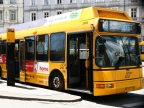
Here are some of the major services in Denmark.
- Copenhagen service is run by Movia at www.movia.dk
- Arhus service is run by Midttrafik at www.midttrafik.dk
- Aalborg it is Nord Jyllands Trafik at www.nordjyllandstrafikselskab.dk
- Odense service is Fynbus at www.fynbus.dk
- Southern Denmark is covered by Sydtrafik at www.sydtrafik.dk
I am only including the public transport companies. There are many privately run companies too.
Riding the bus: How to
Stops are marked by signs with the route numbers on them. The signs are yellow. Underneath, you will see the timetable for each bus that stops there. You do not have to signal for it to stop. If you are standing next to the sign, they will stop. If there are several lines stopping at the stop, stand near the sign, so the driver knows you are waiting for that particular one. If you are standing up on the sidewalk against a wall and the bus is coming by, the driver may not realize that you are waiting for him and will drive on by.
They are not like trains, they do not stop at all stops. They only stop if a passenger has hit the stop button or if someone is waiting at the stop to get on.
Also different buses travel different routes and make different stops even when the route number is the same. Learn what type to take and what all those letters mean after the route number. Check out the various types for all the low down.
Occasionally, they will stop at a stop because they are ahead of schedule and need to wait a few minutes to get back on schedule.
 bus sign
- When the bus stops, you enter by the front door – not the back or middle doors, which are used for exiting. The exception is if you are taking a baby stroller with you. Then you can enter through the middle doors and once on and situated, go down the aisle to the front to buy your ticket or show the driver you have a valid pass/ticket.
- When you board, enter on the right side of the front door if you need to buy a ticket. Enter on the left side of the front door if you have a pass or need to stamp your card.
- There is a small rail by the front doors. At the top of the rail there is a ticket machine, which you use to stamp your klippekort.
- If you have a valid ticket or pass, show it to the driver as you walk by. Make sure he/she sees the ticket. They will usually say “tak” or nod their heads in acknowledgement.
- There are no reserved seats, but some seating areas do have signs showing seats available for the disabled or elderly. You can sit there, but if an elderly person or handicapped person needs the seat, you need to relinquish it. It's best to choose another seat if it is available. Remember a valid ticket is for one seat, so do not place your belongings on the adjacent seat if it is crowded.
- Also, you can stand in the aisle when it is full. There are handles or straps above you, which you can hold on to. During peak hours, it will be packed, and it will be necessary to keep moving towards the back at each stop. People get off and others are getting on, so you NEED to move towards the back.
- In the middle section, there is usually a wide space to stand. The problem with standing there is that people with strollers have first right to those places. If you are standing there, you have to move and give them the spot for their stroller or baby carriage. This can be a real pain when the it is packed and 2 people with strollers try to get on. You just have to move. This is always fun during rush hour. Avoid standing in front of the exit doors - the driver will not drive if you are standing there.
- You exit from either the middle doors or the back door. Along the bus you will see lots of little red buttons. These are mounted on the bars along the seats or sometimes above your head. Just take a look around and you will see plenty of them within easy reach.
- When you are ready to get off, you just push the red button and there will be a little "ding". Near the front above the drivers area, you will see a light that says “Standser”, meaning the driver will be stopping at the next stop. If you see the light lit up, you don't have to push the button again.
- The driver won't usually stop between official stops. Press your button as soon as you know your stop is next. If you wait to push it right before the stop, the driver may assume you are pushing it for the following stop.
- Get up and stand near the door before you reach your stop. Sometimes it can be hard to get through the mass of people if it is rush hour. Drivers try to keep to a tight schedule, so if they have to wait for you to get out of your seat and get to the exit after they stop, this will cause problems. Be ready and help keep the system working. If you do not make it in time - yell at the driver so he knows you are trying to get off. Yell "Jeg skal af "
Helpful Riding Tips
- Buses do not have to stop at all their stops unless there is someone to pick up or someone has pushed the button to get off. Do not assume they will stop. Make yourself visible to the driver, so they will stop.
- During peak travel times, they may not stop at your stop, even if someone is waiting at the stop. This is very common during rush hour. Basically, the bus is so packed with people that the driver cannot take any more passengers. You will have to wait for the next one.
- In the city, there are so many buses that if you miss one, another one will be by shortly. Also, many buslines travel similar routes, so plan alternatives if one is late or full.
- If you are furthur out in the country and the stops are farther apart, it is usually okay to ask the driver to make an unscheduled stop. Don’t ask him to drop you off 100 feet from the regular stop, but often you may need to get off a mile earlier, for example. You can also wave one down when in the country. Don’t try this in the city – they won't do it unless you are a regular customer and even then it might not happen.
- There are several different types of buses. The yellow ones are regular city buses and stop at more stops than some of the other lines.
The rest of Denmark's transport system works on a similiar system with just a few minor differences.
For example, in Aarhus, you board the yellow buses from the back and depart from the front. You don't show your ticket to the driver; you are on the honor system - similar to riding the trains and metro in Copenhagen.
Now if you take a blue Rutebus in Århus, it is like taking the ones in Copenhagen: you enter from the front, exit from the middle, show your ticket to the driver, etc.
The best way to be sure is watch others who are boarding or just ask the driver. Most drivers speak Danish, English and, often, German. If you cannot speak with them, there will be people onboard who can help. Just relax and follow the rules above and you should have an enjoyable experience. After the first few times it will be SO easy.
Other Transportation Information
Below is list of some of the other transportation related pages on FYI Denmark, so you choose which mode you wish to learn more about.
|
|
|
If you found this page helpful, please give a google+ and or a facebook like at the top of the screen, so others can also find this information. Thank you.
Please feel free to comment on this subject
Do you have a helpful tip or comment on this subject that you would like to share? Please leave comments below.
What Other Visitors Have Said
Click below to see contributions from other visitors to this page...
Can we bring big luggage on the buses 
Im plnning to take Bus 143 to billund after a train ride from copenhagen to vejle. Do these buses have a luggage hold to store luggage? I do not wish to …
Thanga Balaji
Hi,
It was on 17.05.2024(Tuesday) I traveled from lautrupbjerg to Malmparken in evening around 4.30 to 5.00 CET in 55E. I lost my travel pass some …
Not vaild anu more
Out of date. Are no klipppekorts any more.
Ticket fine on bus in Denmark
Hi ! I have received a fine in the bus in Copenhagen and I want to pay it online. But is there a web site I have to go on to pay or have I to pay from …
Do buses announce the name of the next stop? Not rated yet
Will the next stop be displayed or announced?
Answer: It is usually only displayed on the monitor at the front of the bus. If you ask the driver to …
Lost Bus Card in Copenhagen! Not rated yet
Hello Good day. What will I do if I lost my bus card? How can I have it again? Do I need to pay again.
Response: Hi. If you are talking about a klippekort …

Quality facemasks are in high demand and hard to find. We have found these quality masks here for only 14kr. Going fast so get yours today! Click Here.
Recent Articles


-
Home Furnishing Shops in Denmark
Feb 16, 24 11:10 AM
 There are many home furnishing shops in Denmark, yet not all have physical stores nor are they well known. To find the best prices ind quality, check out some of these shops
 -
Useful Danish Phrases
Oct 07, 21 07:28 AM
 Learning a few useful danish phrases or words can go a long way to making your stay or visit in Denmark more enjoyable.
 -
Aarhus Attractions
Oct 07, 21 07:08 AM
The number of Aarhus attractions may not be as big as Copenhagen, but there is still alot to see and do in this Danish city.

SBI!