National Bird of Denmark
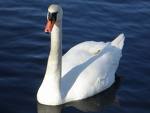
The National Bird of Denmark is the Mute Swan (Cygnus olor) or Knopsvane (of course), made famous in the story by Hans Christian Andersen, "The Ugly Duckling". If you have never seen the movie, watch the clip below. Unfortunately, Danny Kaye's family has removed the video due to infringement rights, so have included a Walt Disney version. Not as good as Danny Kaye's but you will get the gist.
Is this the national bird of Denmark?
Below is another video from the same movie - just love this movie (well most of it - the ballet portion got a bit weird), but Danny Kaye singing Hans Christian Andersen songs never gets old.
Back in 2008, the Mute Swan made history. The oldest living Mute Swan was found dead on Christmas Day 2008 in Korsør Skovstrand. The Mute Swan had been tagged or ringed (a method of tagging invented by the Danes in 1899) back in 1970, when it was reported to be a year-and-a-half old. When found on Christmas Day, it had survived 3 very, very tough winters and made it to the ripe old age of 40 years. This is historical for the Mute Swan, since the second oldest Mute Swan was only 28 when it died.
In the 1920's - the National Bird of Denmark -the Mute Swan was nearly extinct, until in 1926 it became a protected species and has now regained its population and is seen all over Denmark and most of northern Europe.
They breed in colonies all over Denmark and are a magnificent bird to see. Just do not get too close ... they can be vicious if confronted or threatened.
As one of the heaviest flying birds, the Mute Swan can grow to about 65-inches long, have a wingspan of nearly 95 inches and stand nearly 4 feet high, which is quite impressive and scary if confronted by an angry Mute Swan.
The male Mute Swan (known as the cob) is generally larger than the female Mute Swan (known as a pen) and is also distinguished by a larger knob on its beak. The cob weighs on average 25 pounds, while the pen is usually under 20 pounds.
At an early age the Mute Swan or cygnet is not always white and is usually an off-white, grey or brownish tint. Their beaks/bills are black and it is not until after their first year that they turn all white and the beak/bill gets its orange color.
This is where the Hans Christian Andersen story has its origins. Many Mute Swans are ugly ducklings – some cygnets are white, but most are not - but all Mute Swans are white when they mature.
And that is the story of the National Bird of Denmark.
P.S. The Mute Swan did not become the National Bird until 1984, when the national bird was actually the Skylark Alauda arvensis
See, you didn't know all that and you thought you knew it all. ;) Just a little bit of trivia for that next dinner party.
Well, I thought it was interesting. If you want to learn more about other birds of Denmark check out National Bird of Denmark and other birds list
Continue learning more interesting facts about Denmark.
|
|
|
If you found this page helpful, please give a google+ and or a facebook like at the top of the screen, so others can also find this information. Thank you.
Please feel free to comment on this subject
Do you have a helpful tip or comment on this subject that you would like to share? Please leave comments below.

Quality facemasks are in high demand and hard to find. We have found these quality masks here for only 14kr. Going fast so get yours today! Click Here.
Recent Articles


-
Home Furnishing Shops in Denmark
Feb 16, 24 11:10 AM
 There are many home furnishing shops in Denmark, yet not all have physical stores nor are they well known. To find the best prices ind quality, check out some of these shops
 -
Useful Danish Phrases
Oct 07, 21 07:28 AM
 Learning a few useful danish phrases or words can go a long way to making your stay or visit in Denmark more enjoyable.
 -
Aarhus Attractions
Oct 07, 21 07:08 AM
The number of Aarhus attractions may not be as big as Copenhagen, but there is still alot to see and do in this Danish city.

SBI!