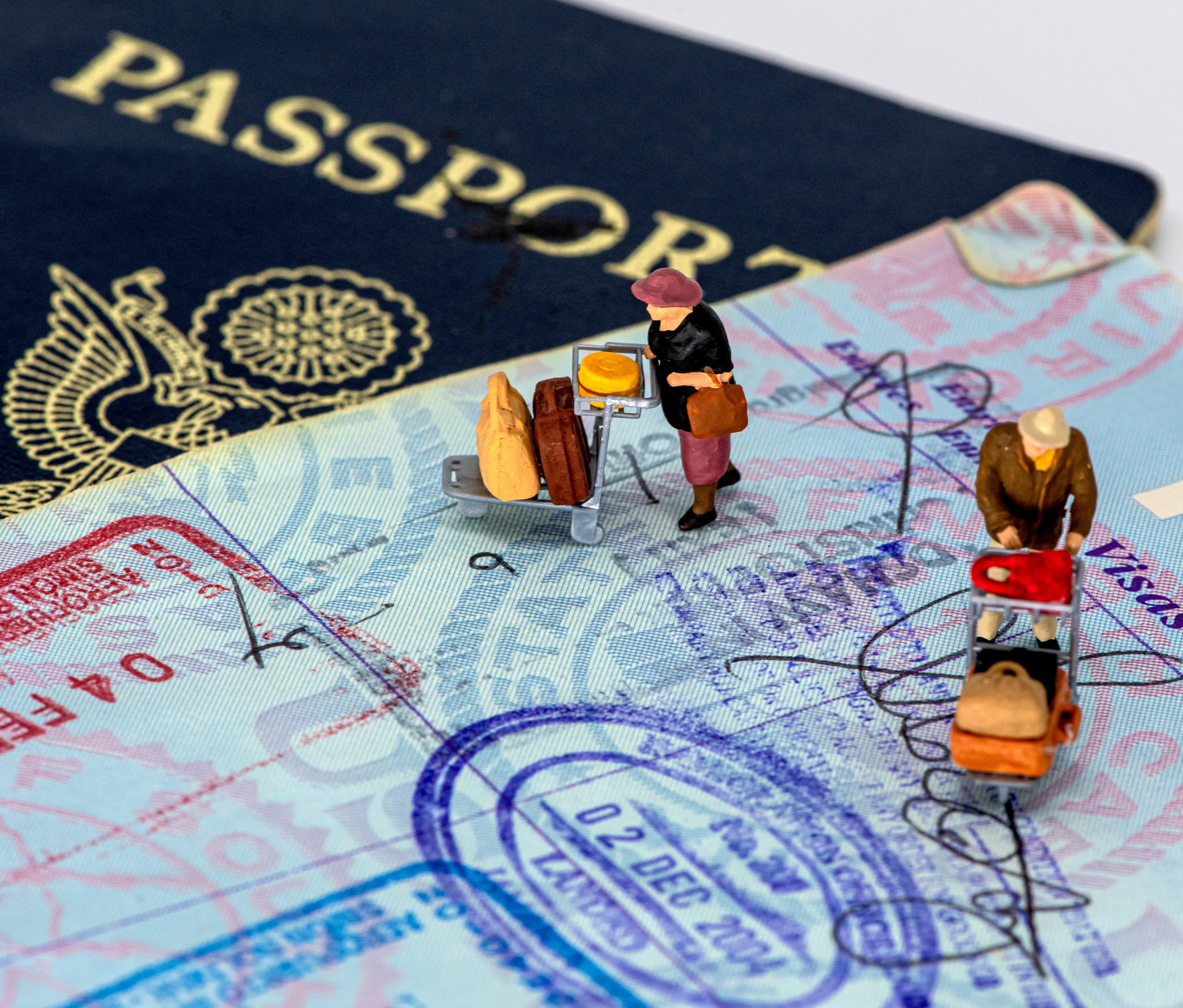
Documents for Denmark
Before your arrival, it is very important to get all your documents for Denmark in order. Take my word for it, it will make your life so much easier. The bureaucratic wheels turn slowly - very slowly at times.
You may wish to check out the new Green Card Scheme , which may help you qualify for both residency and work permits on a point system. It is not easy, but for many it may be a blessing. The system is being updated, since Denmark is lagging far behind in recruiting some of the top people to their shores.
Passports
The most important documents for Denmark is of course a valid passport.
A valid passport, which is good for at least 3 months longer than your arrival date, is needed to visit Denmark. So if your passport is going to expire within 3 months of your arrival date, it is advisable to get it renewed before arriving. Since people are traveling to Denmark from all over the world, it would be hard for me to list all the exceptions and rules. I will try to be as up-to-date as possible, but please do check with your local Danish Embassy or consulate, as well as your own embassy, for confirmation.
EU citizens can enter Denmark using only identity cards, but there are exceptions for some of the Slavic countries. Again, you can check with your local embassy for more details, since they are changing constantly.
When traveling it is always best to have your travel documents for Denmark with you at all times; never leave them at your hotel or in your vehicle. Keep photocopies of your documents (passport, birth certificate, driver's licence, identity card, etc.) in a safe place in case the originals get lost or stolen. This can save you a lot of aggravation if something does go wrong.
More details can be found at Ministry of Foreign Affairs.
Visa
The next important documents for Denmark is a visa and various permits if you plan on an extended stay.
If you are planning on staying longer than 3 months in Denmark, you will need to get a visa. A visa is a stamp in your passport that gives you permission to extend your stay in Denmark for various reasons.
There are various visa documents for Denmark such as work permits, study permits, tourist permits, and business permits. It is best to get your visa before you arrive in Denmark, even though you can get one after you arrive. The problem is that the system can be very slow at times. You may have to relinquish your passport if you are sending in an application. That can cause problems if you need your passport for other things. Personally, I recommend doing it before you travel.
Get all your documents for Denmark you need in order; it will make your life simpler. Always check with your local embassy or with your travel agency to confirm.
Below is a list showing citizens of which countries divided into who will need a visa and those who do not need a visa as part of the required documents for Denmark.
No Visa RequiredAndorra, Argentina, Australia, Austria, Belgium, Brazil, Brunei Darussalem, Bulgaria, Canada, Chile, Costa Rica, Croatia, Cyprus, Czech Republic, Salvador, Estonia, Finland, France, Germany, Greece, Guatemala, Honduras, Hungary, Iceland, Ireland, Israel, Italy, Japan, Latvia, Liechtenstein, Lithuania, Luxembourg, Malaysia, Malta, Mexico, Monaco, Netherlands, New Zealand, Nicaragua, Norway, Panama, Paraguay, Poland, Portugal, Romania, Salvador, San Marino, Singapore, Slovakia, Slovenia, South Korea, Spain, Sweden, Switzerland, United Kingdom, United States, Uruguay, Vatican City State, Venezuela The following are not documents for Denmark, but more a list of conditions that may help or impede your application. 1. You must have enough funds to cover the cost of your stay. Which will include your family. Norm is 350 kroner per diem. 2. You must not be on the SIS undesireable list. This is a list which is used by members of the Schengen Treaty to inform fellow members of individuals who may be harmful to national security. 3. You must not be listed on the Danish Entry Ban List. This is usually someone who has been in Denmark before and deported. 4. You will be required to have insurance to cover any medical expenses incurred while in Denmark or enough money cover for your trip home. |
Need Visa RequiredAfghanistan, Albania, Algeria, Angola, Antigua/Barbuda, Armenia, Azerbaijan, Bahamas, Bahrain, Bangladesh, Barbados, Belarus, Belize, Benin, Bhutan, Bolivia, Bosnia-Herzegovina, Botswana, Burkina Faso, Burma, Burundi, Cambodia, Cameroon, Cape Verde, Central African Republic, Chad, China, Colombia, Comoros, Congo, Cuba, Democratic Republic of Congo, Djibouti, Dominica, Dominican Republic, Ecuador, Egypt, Equatorial Guinea, Eritrea, Ethiopia, Fiji, Gabon, Gambia, Georgia, Ghana, Grenada, Guinea, Guinea-Bissau, Guyana, Haiti, India, Indonesia, Iran, Iraq, Ivory Coast, Jamaica, Jordan, Kazakhstan, Kenya, Kiribati, Kosovo, Kuwait, Kyrgyzstan, Laos, Lebanon, Lesotho, Liberia, Libya, Madagascar, Macedonia, Malawi, Maldives, Mali, Marshall Islands, Mauritania, Mauritius, Micronesia, Moldovia, Mongolia, Montenegro, Morocco, Mozambique, Namibia, Nauru, Nepal, Niger, Nigeria, North Korea, Northern Marianas, Oman, Pakistan, Palau, Papua New Guinea, Peru, Philippines, Qatar, Russia, Rwanda, Samoa, Sao Tomé and Principe, Saudi Arabia, Senegal, Serbia, Seychelles, Sierra Leone, Solomon Islands, Somalia, South Africa, Sri Lanka, St. Christoffer and Nevis, St. Lucia, St. Vincent and the Grenadines, Sudan, Suriname, Swaziland, Syria, Taiwan, Tadjikistan, Tanzania, Thailand, Timor-Leste, Togo, Tonga, Trinidad and Tobago, Tunesia, Turkmenistan, Tuvalu, Uganda, Ukraine, United Arab Emirates, Uzbekistan, Vanuatu, Vietnam, Yemen, Zambia, Zimbabwe, Passports issued by the Palestinian Authority |
Work and Residence Visa
One of the most important documents for Denmark is your WORK VISA and RESIDENCE PERMITS
Important Note:: Please be aware that there are now NEW fees for applying for some of the work schemes available. You can download it here - application fees . These fees do change constantly, so this is just a guide.
Work visas are granted to people who are planning to reside and work in Denmark. These are stamped inside your passport and state that you are allowed to live and work in Denmark. Usually, they are valid for 4 years and can be renewed.
The current rules for working in Denmark are as follows:
If you are a citizen of Norway, Sweden, Finland, Greenland, or Iceland there are no restrictions on living and working in Denmark.
If you are a member of any EU country you can come to Denmark and seek work. If you get work you can apply for a residency permit without much of a problem. If you have criminal ties or other background problems, you may find it a bit difficult to be granted either a work or residency permit, since Denmark is really coming down hard on such individuals.
If an EU citizen gets work and the job pays enough to support them, they will usually be granted a residency permit.
If you come from outside the EU, you will need to get a work permit before coming to Denmark. If a company offers you a position in Denmark, they will usually secure your work permit for you. You can also apply for a work permit if you are living here, but it is much harder to get and there is no guarantee that it will be given to you.
PLEASE NOTE: Immigration rules have tighten over the past year and it is very important that you have your permits in order before arriving in Denmark.
There are several other immigration schemes available, such as the Green Card Documents for Denmark. You can aslo try to work/residence permit under one of these other immigration schemes.
Salaried Worker : Download the Salaried Job Application Form
Green Card Scheme: Download the Green Card Application Form
Religous Worker: Download the Religous Scheme Application Form
Self Employed: Download the Self Employed Application Form
Researcher or Research Assistant: Download the Researcher Application Form
Corporate Scheme: Download the Corporate Scheme Application Form.
There are a few others such as working as a nanny, being a student and asylum seekers.
You can find more details about all these schemes and more about integration at Ny i Danmark.
Ny i Danmark, just means new to Denmark and is the official immigration site with all the latest official documents. But the best way is to contact the Immigration Service by phone on 0045 35 30 87 71 between the office hours of 9am to 3PM.
If you are in Denmark, go by their office at Ryesgade 53,2100 Copenhagen Ø. The service center opens at 8:30AM, but suggest you get there earlier since lines form sooner than that and the wait can be quite long. Opening hours 8:30 to 12noon and Thursday evenings from 3:30 PM to 5:30PM.
P.S. I got there one day at 7AM and the line had already started forming.
Consult your local embassy for assistance if you find yourself living in Denmark and unable to get a work permit. They may be able to help.
Family Reunification Plan Documents for Denmark
For families outside of the EU, immigration is getting more expensive and harder to handle for many.
The Danish Immigration Service will want the Danish partner to have at least 126,000 kroner in their bank account to help cover living costs and expenses before the applicant will be allowed to bring their spouse or family into Denmark.
Your spouse will have to visit Denmark twice before being allowed to immigrate. On one of those trips, your spouse will have to sit for a language test.
The application fee is 7775 kroner.
Immigration test fee is 3600kr.
These high fees are are due in part to the high costs associated with immigration, which has increased dramatically and they are trying to offset some of these and also weed out some of the immigrants who are coming to Denmark to live off the social system.
New fees and conditions are constantly being imposed by the government, yet some of these changes have backfired and they may be repealed in order to get more highly qualified job seekers to Denmark.
Other Documents needed when moving to Denmark
The documents for Denmark listed above are mostly government issued documents. You, as an expat, will need to provide a list of your own support papers. Here is a brief list of things that you should have with you when entering Denmark, so that you can prove who you are.
|
|
|
|
|
If you found this page helpful, please give a google+ and or a facebook like at the top of the screen, so others can also find this information. Thank you.
Please feel free to comment on this subject
Do you have a helpful tip or comment on this subject that you would like to share? Please leave comments below.
What Other Visitors Have Said
Click below to see contributions from other visitors to this page...
i return to my country, what about CPR number ? 
My son lived in copenhaguen since 3 years, but now he has to return to our country because family problems. What we have to do with his CPR number ? thanks …
DANISH CITIZEN WITH US SPOUSE
I am a danish citizen and my spouse is US citizen thinking about retiring to Denmark (not working) age 79 and 81 .How difficult would this be ?
moving adress
hi, my husband and I lived in Sweden. but since my husband work in Denmark and he is from Denmark.so we are planning to move in Denmark soon.but I got …
Mr.
Suddenly ,I am desired to be immigrant in a developed country .Thus , I have been searching information on countries which give opportunity . Denmark …
Interested in movie to Denmark
Hello.
My husband and I are interested in traveling the world with our 1 year old daughter. We're wondering about some things in regards to having a …

Marriage requirements paper Not rated yet
I want ask something about marriage.thank you.
Visa for USA from Denmark Not rated yet
Hi, Can you guide me with this... Can a Pakistani student having a residence permit here for 3 years need a visit visa for USA? If yes, how much does it …
US Passport for entry into Denmark Not rated yet
Hi I have a client that is a US citizen and she is leaving to go to Copenhagen on the Apr 5 2015 and arrive in Copenhagen on the 6 Apr and return on the …
What are required documents for moving to Denmark? Not rated yet
Do I need to submit Birth certificate of me and my wife for immigration of Denmark?
Response from FYI Denmark:
You will need both birth and wedding …
Applying for Danish resident permit. Not rated yet
I wish to apply for a resident permit.
Kindly send me information
Response: We do not provide resident permit, that is done by the government. More …

Quality facemasks are in high demand and hard to find. We have found these quality masks here for only 14kr. Going fast so get yours today! Click Here.
Recent Articles


-
Home Furnishing Shops in Denmark
Feb 16, 24 11:10 AM
 There are many home furnishing shops in Denmark, yet not all have physical stores nor are they well known. To find the best prices ind quality, check out some of these shops
 -
Useful Danish Phrases
Oct 07, 21 07:28 AM
 Learning a few useful danish phrases or words can go a long way to making your stay or visit in Denmark more enjoyable.
 -
Aarhus Attractions
Oct 07, 21 07:08 AM
The number of Aarhus attractions may not be as big as Copenhagen, but there is still alot to see and do in this Danish city.

SBI!